UI/UX

FINTECH

2024

Zedcrest Wealth Academy

A financial literacy platform built into the Zedcrest Wealth app, designed to turn people who signed up but never came back into people who learn, engage, and stick around.

Role & contribution

Role & contribution

I led the product design for the Zedcrest Wealth Academy, helping shape the experience from early roadmap conversations through to launch.

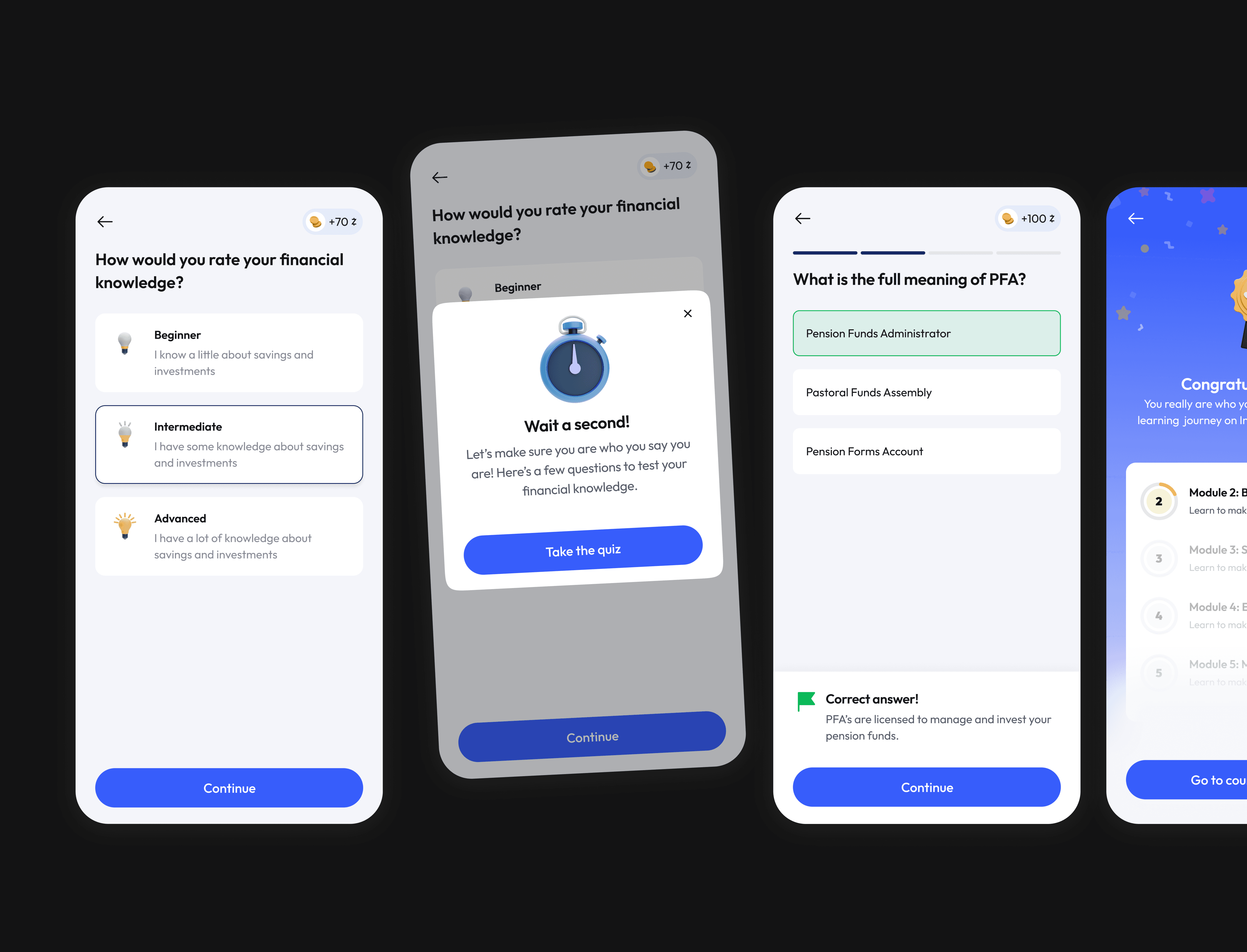
My work included defining the overall learning experience, designing the assessment and knowledge-tier flow, prototyping and testing different lesson formats, and creating an early demo for TechCabal's Moonshot event in October 2024.

I worked closely with another product designer, a 3D asset designer who developed the illustration system, engineers, QA, product managers, and marketing throughout the project, from early exploration through implementation and launch.

Timeline

Timeline

August 2024 - November 2025

August 2024 - November 2025

Tools

Tools

Figma, Azure, Loom, Teams

Figma, Azure, Loom, Teams

The Gap Between Signing Up and Showing Up

The Gap Between Signing Up and Showing Up

While planning our H2 2024 roadmap, we found a problem in our numbers. Sign-ups were climbing steadily, but product usage barely moved. People were interested enough to join. They just were not coming back.

Cross-functional conversations with product, marketing, and client services pointed to a potential reason: users did not always feel confident enough in their financial knowledge to take the next step.

So we set out to create something that could close that confidence gap directly, a learning experience embedded in the product they had already signed up for.

While planning our H2 2024 roadmap, we found a problem in our numbers. Sign-ups were climbing steadily, but product usage barely moved. People were interested enough to join. They just were not coming back.


Cross-functional conversations with product, marketing, and client services pointed to a potential reason: users did not always feel confident enough in their financial knowledge to take the next step.


So we set out to create something that could close that confidence gap directly, a learning experience embedded in the product they had already signed up for.

While planning our H2 2024 roadmap, we found a problem in our numbers. Sign-ups were climbing steadily, but product usage barely moved. People were interested enough to join. They just were not coming back.


Cross-functional conversations with product, marketing, and client services pointed to a potential reason: users did not always feel confident enough in their financial knowledge to take the next step.


So we set out to create something that could close that confidence gap directly, a learning experience embedded in the product they had already signed up for.

Meeting Users Where They Are

Meeting Users Where They Are

Financial literacy content has a familiar problem, particularly in Nigeria. Many retail investors are relatively new to formal investing. Years of Ponzi schemes and naira volatility have also made people understandably cautious about financial products. At the same time, much of the content designed to educate them assumes a baseline level of knowledge they may not have.

The result is often the same. First-time investors get lost in unfamiliar terminology, while people with some existing knowledge get bored covering what they already know.

Giving everyone the same starting point meant losing people at both ends.

The Academy was designed to meet people closer to where they were. We created a short assessment that grouped users into one of three knowledge tiers and recommended a starting point based on their results.

Financial literacy content has a familiar problem, particularly in Nigeria.

Many retail investors are relatively new to formal investing. Years of Ponzi schemes and naira volatility have also made people understandably cautious about financial products. At the same time, much of the content designed to educate them assumes a baseline level of knowledge they may not have.

The result is often the same. First-time investors get lost in unfamiliar terminology, while people with some existing knowledge get bored covering what they already know.

Giving everyone the same starting point meant losing people at both ends.

The Academy was designed to meet people closer to where they were. We created a short assessment that grouped users into one of three knowledge tiers and recommended a starting point based on their results.

Choosing How a Lesson Should Read

Choosing How a Lesson Should Read

We wanted lessons to feel like something you would actually finish, not another wall of financial jargon.

I prototyped two formats: a horizontal, swipe-through experience and a standard vertical scroll. We tested both with users to understand which format felt easier to consume and navigate.

The horizontal format was preferred by 75% of participants. Users found it easier to digest and liked having a clearer sense of how much of the lesson was left. So we went horizontal. But that decision came with a technical trade-off.

Hardcoding lesson content and images directly into the app would have increased the app's size and made content updates dependent on new releases. Instead, the mobile engineers built the content pipeline through Strapi, allowing the team to update lessons without shipping a new version of the app.

The trade-off was flexibility. Strapi could not support every layout and interaction from the original designs, so some of the visual polish had to be adapted to work within what the CMS could actually render.

The horizontal format was preferred by 75% of participants. Users found it easier to digest and liked having a clearer sense of how much of the lesson was left. So we went horizontal. But that decision came with a technical trade-off.

Hardcoding lesson content and images directly into the app would have increased the app's size and made content updates dependent on new releases. Instead, the mobile engineers built the content pipeline through Strapi, allowing the team to update lessons without shipping a new version of the app.

The trade-off was flexibility. Strapi could not support every layout and interaction from the original designs, so some of the visual polish had to be adapted to work within what the CMS could actually render.

The Reward System

The Reward System

Every lesson ends with a quiz, and passing unlocks a reward. The reward system was not a difficult sell internally. Zedcrest Wealth already used gamified experiences like the weekly tournaments in the game centre, so extending that pattern to the Academy felt more like continuity than a completely new experiment.

The harder question was what happened when someone failed.

  1. Do they move on anyway?

  2. Do they have to repeat the lesson?

  3. If they try again, should they get a different set of questions?

After exploring the options, we chose the simpler approach: users would retake the lesson and attempt the same quiz again.

It was easier to build and reason about, although it came with an obvious limitation. Users who needed several attempts would eventually see the same questions repeatedly.

From Prototype to Product

From Prototype to Product

Following extensive iteration and close collaboration with engineering, we ran a final usability study with external users in August 2025. Zedcrest Wealth Academy shipped in November 2025 and is now live on iOS and Android.

Initial public feedback has been positive, and the Academy remains an active project as the team continues to collect data and plan future improvements.

Looking Back

Looking Back

There are two things I would do differently. First, our testing pool skewed young, with most participants between 18 and 25. A wider age range would have given us more confidence that the experience worked for people with different levels of familiarity with technology and investing.

Second, I would revisit the knowledge tiers. Three options gave the experience structure, but an additional "other" option could have helped us better understand users who did not fit neatly into the categories we created.

Check out Zedcrest Wealth on Google Play Store or Apple App Store.

Create a free website with Framer, the website builder loved by startups, designers and agencies.